Best Mini Split for a Garage: Sizing, Power, Install
How to pick a mini split for a garage, workshop, or shed: sizing a 20x20 garage, insulation, 115V vs 230V, cold-weather limits, DIY vs pro install.
At a glance
A 12,000 BTU mini split suits a typical 20x20 garage if the walls, ceiling, and door are insulated. The MRCOOL DIY 4th Gen is a quick-connect 115V pick, the Della Optima lists heating to -13°F, and the Senville AURA lists heating to -22°F.
A garage is the hardest room in the house to condition and one of the most rewarding. It is usually the least insulated space under your roof, it has a huge door that leaks air, and it may double as a workshop, a gym, a hobby room, or a place to keep a project car out of the weather. A ductless mini split is a popular answer because it needs no ductwork, heats and cools from one outdoor unit, and uses far less power than a space heater. This guide covers what matters before you pick a model: how big the system needs to be, what your electrical panel can support, how cold it can get outside, and who should do the installation. Then we match models from our list to common garage setups.
We do not test products ourselves. Specifications below come from the manufacturers’ published pages and brochures, and general guidance comes from ENERGY STAR, the EPA, and the IRS pages listed under Sources.
The Short Answer
- For a typical 20x20 garage (400 sq ft) that is reasonably insulated, a 12,000 BTU single-zone heat pump is the usual starting point.
- Insulation and air sealing decide how well any system performs. A bigger unit will not fix a bare ceiling and a leaky door.
- Check your panel first. Some 12K models run on 115V and some need a 230V circuit, and both need a dedicated circuit and a disconnect.
- Only quick-connect DIY kits are designed for homeowner installation. Flare-connection systems need a vacuum, a leak check, and a technician who is allowed to handle refrigerant.
- For cold garages, compare the heating range each maker lists, and plan for backup heat on the worst days.
Sizing a Garage: Start With the Envelope
A 20x20 garage is 400 square feet. Several of the 12,000 BTU systems on our list state coverage of up to 550 sq ft according to their makers, which sounds comfortable. However, those figures assume a normal, insulated room. A garage differs in four ways:
- The door. A thin, uninsulated metal door is a large, leaky surface. An insulated door with good weatherstripping changes the load a lot.
- The ceiling. A bare ceiling under an attic, or an open roof with no insulation, loses heat in winter and gains it in summer.
- The slab and walls. Exposed block or uninsulated stud walls drag the temperature toward the outdoor air.
- The height. Tall ceilings mean more air to condition.
ENERGY STAR’s ductless page says a system that is too large or too small will struggle to meet your needs, and that a Manual J load calculation is how a contractor verifies the size. We would add a simple rule of thumb: spend on the garage door seals and ceiling insulation first if the space is bare, because that lowers the size you need and the energy you use every year.
Oversizing has a cost too. Inverter systems can turn their compressors down, which helps, but a unit that is much larger than the load still spends its time near the bottom of its range. If you are between sizes, a well-insulated 400 sq ft garage points to 12K, and a poorly insulated one points to getting a load calculation before buying anything bigger.
12K or 18K, and When One Unit Is Not Enough
Most readers who search for a mini split for a garage are looking at a one-ton, 12,000 BTU unit. That fits a one- or two-car garage with decent insulation. A larger 18,000 BTU outdoor unit makes sense when the garage is bigger or taller, or shares a wall with a heated room you also want to condition.
A shop is another matter. If you are thinking of a 2,400 sq ft shop, none of the single-zone 12K units on our list is the answer. You are in multi-head or larger-system territory, and the right design comes from a load calculation, not a product page. We say this plainly because a 12K unit in a space that big would run flat out and still fall short. The 2-zone MRCOOL system below conditions two rooms, such as a garage plus an adjoining bonus room, but it is not designed for an open shop of that size.
Power: 115V, 230V, and What Your Panel Can Carry
This question quietly decides the project. Mini splits run on a dedicated circuit, and the outdoor unit needs a disconnect within sight of it. Several of the garage-friendly 12K units on our list are 115V, which avoids running a 230V circuit if your panel is full. Others need 208-230V.
According to the makers:
- The MRCOOL DIY 4th Gen 12K and the Della Optima 12K are 115V systems.
- The Senville AURA 12K is a 208/230V system.
- The MRCOOL DIY 5th Gen 2-Zone needs a 208-230V dedicated circuit.
Read the nameplate data on the unit you buy for the breaker size and wire gauge, then have the circuit installed to the National Electrical Code and your local rules. Many areas require a permit and a licensed electrician for new circuits, and a detached garage or shed may need a feeder from the house panel. Do not size the breaker from memory or a forum post.
Cold Garages: Read the Heating Range Carefully
If your garage sits in a northern state, how the unit heats in cold weather matters more than its cooling rating. Two of our picks list an unusually low heating range: Della lists operation down to -13°F for the Optima, and Senville lists heating down to -22°F for the AURA. An operating limit is not the same as full output, though. Capacity drops as the outdoor temperature falls. ENERGY STAR’s page says certified units are verified for low-temperature performance with testing down to 5°F, that units keep working below that, and that pairing one with a backup heat source is most efficient at lower temperatures.
For a garage that is also a workshop, a small backup heater for the coldest week of the year is a sensible plan. The mini split carries the load on most days, and the heater covers the exceptions.
Mount the outdoor unit on a stand or bracket above the usual snow line, keep it clear of roof runoff and drifting snow, and leave room for defrost water to drain away from walkways and the garage apron where it can freeze.
Where to Mount the Indoor Unit
A garage is dusty, and some garages have fumes. Some practical guidance:
- Mount the indoor unit high on a wall with clear airflow across the space, away from the spot where you park, sand, grind, or spray.
- Keep the washable filter in mind: dust will load it faster than in a living room, so plan to clean it often.
- Plan the condensate drain with a continuous slope to a safe spot outside. A drain that dumps onto a walkway can freeze.
- If you store fuel, solvents, or other flammables in the garage, check the unit’s manual and your local code about where electrical appliances can sit, and ask your installer. We did not find a manufacturer statement on this for the models below, so we won’t guess.
DIY or Professional Install
This is where the models split into two groups. MRCOOL’s DIY lines use pre-charged Quick Connect line sets, which are designed so a homeowner can connect the indoor and outdoor units without a vacuum pump or refrigerant handling. You still mount the units, drill the wall, run the drain, and wire the circuit.
The other models on our list use conventional flare-connection line sets. Those need a vacuum and a leak check, and the work involves refrigerant. The EPA’s Section 608 page says technicians who maintain, service, repair, or dispose of equipment that could release refrigerants must be certified, so for flare systems, plan on a certified technician. A professional install also helps protect your warranty, since several makers tie coverage to it.
On incentives, the federal energy-efficient home improvement credit (25C) applied to qualifying property placed in service through December 31, 2025, per the IRS, so it has expired for 2026 installs. Some local utility rebates may exist, and ENERGY STAR’s Rebate Finder is the place to look.
Which Models Fit a Garage
Our full set of profiles covers nine models. These are the ones we would shortlist for a garage, based on the makers’ published specs.
MRCOOL DIY 4th Gen 12K: The Quick-Connect 115V Pick
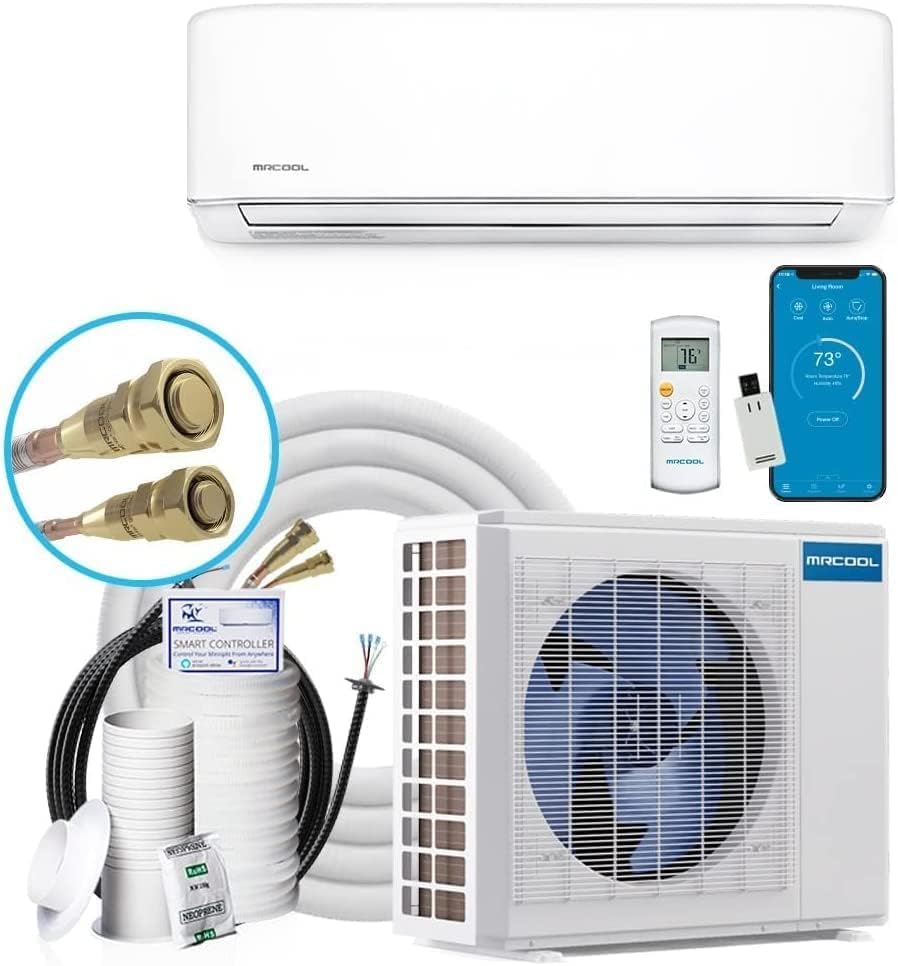
A 115V, pre-charged quick-connect system designed for homeowner installation, with MRCOOL listing coverage of up to 550 sq ft. A fit for a reasonably insulated one- or two-car garage.
According to MRCOOL’s brochure, this model is a 12,000 BTU cool and heat system at 22.5 SEER2 with R-410A refrigerant and an ENERGY STAR listing. R-410A is an older refrigerant that is being phased out for new systems, and retailers report that this 115V 4th Gen has been replaced by a newer generation, so buy it while stock lasts and read the details in our MRCOOL DIY 4th Gen profile.
Della Optima 12K: 115V for Colder Garages
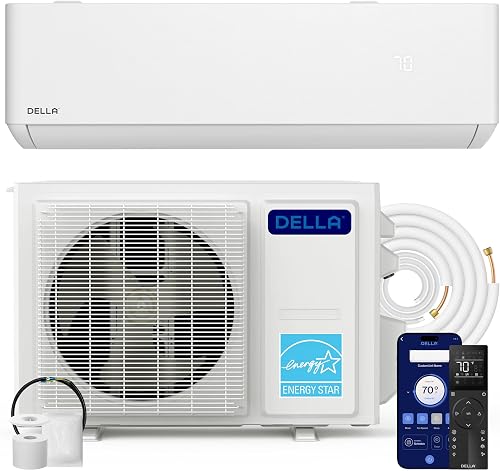
A 115V single-zone unit that Della lists for heating down to -13°F, with coverage up to 550 sq ft. Suits a cold garage or workshop if you plan a professional install.
Della lists 12,400 BTU of heating capacity, 23 SEER2, and an HSPF2 of 10 for region IV, with R-454B refrigerant. It uses a conventional flare line set, so it is not a DIY kit. The standard warranty is one year, with lifetime parts coverage if you register within 100 days, according to Della. See the Della Optima profile for the details.
Senville AURA 12K: The Coldest Heating Range on Our List
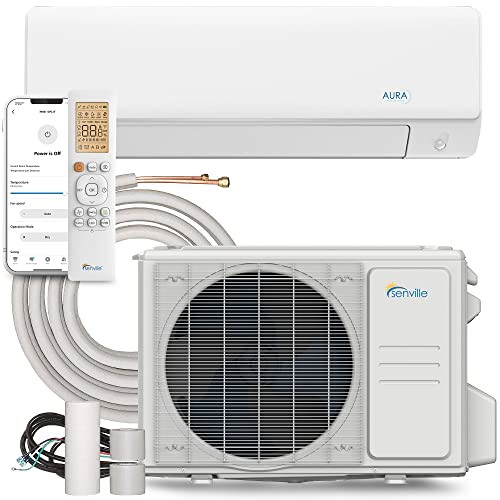
A 208/230V professional-install heat pump that Senville lists for heating down to -22°F. The pick for a garage in a northern state if you can supply a 230V circuit.
Senville lists 25.4 SEER2, HSPF2 of 10.5 for region IV and 8 for region V, and a 10-year compressor warranty with 5-year parts coverage. Indoor sound runs from 24 to 47 dB(A), which matters less in a garage than in a bedroom. Read the Senville AURA profile before you buy.
MRCOOL DIY 5th Gen 2-Zone 18K: Garage Plus a Second Room

Two 9,000 BTU wall units on one 18,000 BTU outdoor unit with quick-connect line sets. Useful when the garage and a bonus room or office share an outdoor wall.
According to MRCOOL’s brochure, the system lists 23.9 SEER2 and HSPF2 of 10.0 for region IV, and it needs a 208-230V dedicated circuit. Each 9K head gives a room less capacity than a stand-alone 12K, so it fits a modest garage plus a small room. See the MRCOOL DIY 5th Gen 2-Zone profile.
How to Choose Among Them
- Mild winters, 115V: the MRCOOL DIY 4th Gen is the easy install while stock lasts.
- Cold winters and 115V only: the Della Optima lists heating down to -13°F, the lowest figure among the 115V units on our list that state one.
- Cold winters and a 230V circuit available: the Senville AURA has the lowest listed heating limit.
- Garage plus an attached room: the MRCOOL 2-zone system.
Whichever you choose, confirm that the model number on the box matches what you ordered, read the current manual, and keep your receipt and registration paperwork.
For the full lineup, including the models not covered here, see our ranking of the best mini splits of 2026.
Sources
- ENERGY STAR: Ductless Heating and Cooling
- EPA: Section 608 Technician Certification Requirements
- IRS: Energy Efficient Home Improvement Credit
- MRCOOL DIY 4th Generation brochure
- Della Optima 12,000 BTU official product page
- Senville AURA 12,000 BTU official product page
- MRCOOL DIY 5th Generation official page
Frequently asked questions
What size mini split do I need for a 20x20 garage?
A 20x20 garage is 400 sq ft. Several 12,000 BTU models on our list are rated by their makers for up to 550 sq ft, so a 12K unit is the usual starting point for a reasonably insulated two-car garage. An uninsulated door, a bare ceiling, or a tall roofline can push the real load higher, and ENERGY STAR says a contractor should confirm the size with a Manual J load calculation.
Can I run a garage mini split on a regular 115V circuit?
Some 12K models are built for 115V, including the MRCOOL DIY 4th Gen and the Della Optima. They still need a dedicated circuit sized to the nameplate, plus a disconnect, installed to the National Electrical Code and local rules. Check what your panel can carry, and ask a licensed electrician if there is any doubt.
Can I install a garage mini split myself?
Only the pre-charged quick-connect kits, such as MRCOOL's DIY lines, are designed for a homeowner to connect without a vacuum pump or refrigerant handling. Systems with flare-connection line sets need a vacuum, a leak check, and refrigerant handling, and the EPA says people who maintain, service, or repair equipment that could release refrigerant must be Section 608 certified. The electrical work may also need a licensed electrician or a permit.
Will a mini split heat a garage in winter?
It can, within its limits. Della lists heating operation down to -13°F for the Optima and Senville lists -22°F for the AURA, but capacity falls as the outdoor temperature drops, so a leaky garage in a cold state may still need backup heat on the coldest days. ENERGY STAR notes that pairing a mini split with a backup heat source is most efficient at the lowest temperatures.
Can one mini split heat a 2,400 sq ft shop?
Not one of the 12K units on our list. A shop that size needs several heads or a larger outdoor unit, and a load calculation from a contractor. The 2-zone MRCOOL system covers two rooms, not a large open shop.
Where should I put the indoor unit in a garage?
Mount it high on a wall with clear airflow, away from where you park, grind, sand, or paint, so dust does not clog the filter. Plan the condensate drain to slope away to a safe spot. Wherever fuel, solvents, or other flammables are stored, follow the manufacturer's manual and local code, and ask your installer.