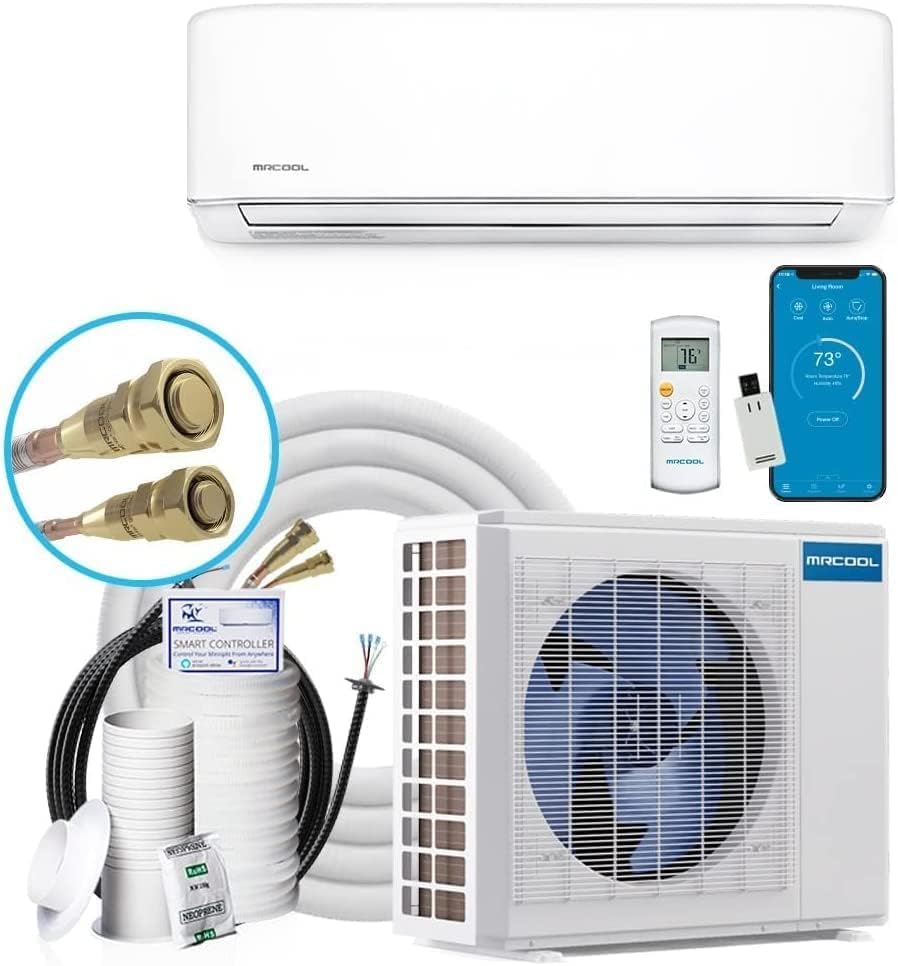
The MRCOOL DIY 4th Gen 12K is a well-known do-it-yourself mini split. It is a 12,000 BTU single-zone heat pump that runs on a regular 115V circuit and ships with a pre-charged line set that connects with Quick Connect fittings. For a homeowner who wants one conditioned room, such as a garage, basement, sunroom, or bedroom addition, it removes the hardest part of a mini split install: handling refrigerant.
This profile compares the numbers MRCOOL publishes. We do not test products, so everything below comes from the maker’s brochure and public sources, and where a detail is missing, we say so.
Quick Facts
According to MRCOOL’s 4th Gen brochure (version dated 02-24-2026), the 12K model, listed as DIY-12-HP-WMAH-115C25 indoors and DIY-12-HP-C-115C25 outdoors, offers:
- 12,000 BTU/h of cooling and 12,000 BTU/h of heating
- 22.5 SEER2 and 12.5 EER2
- HSPF2 of 9.0 for region IV and 7.0 for region V
- 115V, 60 Hz single phase, with a minimum circuit ampacity of 19 A and a maximum fuse of 25 A on the outdoor unit
- R-410A refrigerant, 38.1 oz charge, with 1/4-inch liquid and 1/2-inch gas piping
- Coverage of up to 550 sq ft
- Indoor sound of 37, 31, and 23.5 dB(A) on high, medium, and low, and 53.5 dB(A) outdoors
- ENERGY STAR certified, per the brochure cover
Indoor unit weight is listed at about 24 lbs and the outdoor unit at about 66 lbs, which matters if you are lifting the condenser onto a bracket by yourself.
Who It’s For
This model suits a homeowner who wants cooling plus supplemental heat in one space and is comfortable with basic hand tools. Typical uses include a detached or attached garage, a finished basement, a workshop, a guest room, or a room addition. The 115V supply is the big draw: many homes and outbuildings can spare a 120V circuit more easily than a 240V one. It also suits buyers who want to avoid the installer wait that often comes with refrigerant work.
It is also a reasonable choice if you want ENERGY STAR certification. The brochure lists the line as certified, which can make local utility rebates easier to find. Use the ENERGY STAR Rebate Finder to see what your utility offers; availability and amounts vary widely.
Who Should Skip It
Skip it if you need a primary heat source in a cold region. HSPF2 falls to 7.0 for region V, and the brochure does not give a cold-climate rating for this size. Skip it if you want the newest refrigerant: the 4th Gen uses R-410A, which is being phased out for new systems, while newer lines use R-454B. Skip it if the room is larger than the brochure’s 550 sq ft, or has a lot of glass, a leaky garage door, or no insulation. Finally, skip it if you are not willing to run, or hire someone to run, a dedicated circuit.
Capacity and Sizing
The 550 sq ft figure is MRCOOL’s number for a typical room. Real load depends on insulation, ceiling height, window area, sun exposure, climate, and how many people use the space. ENERGY STAR notes that oversized and undersized systems both struggle to keep you comfortable and suggests a Manual J calculation by a contractor. A common mistake is buying a 12K unit for a 450 sq ft uninsulated garage and expecting it to hold 70°F in January.
Because this is an inverter system, the compressor can slow down at light loads, so a slightly generous size is less harmful than with an old single-speed air conditioner. It still pays to size the unit to the room rather than to your hopes.
Efficiency Numbers, Explained
SEER2 is the seasonal cooling efficiency rating under the updated federal test procedure, EER2 is the efficiency at a fixed hot condition, and HSPF2 is the seasonal heating efficiency. Higher is better in all three. The brochure lists 22.5 SEER2 and 12.5 EER2 for the 12K, which are strong for a 115V system. HSPF2 is listed for two regions: 9.0 for region IV, which includes much of the middle of the country, and 7.0 for region V, the coldest zone. That gap is normal, but it is a reminder that heating output and efficiency fall as outdoor temperatures drop.
The brochure lists 12,000 BTU/h of heating capacity and a Low Ambient Cooling feature. It does not give a minimum heating temperature or a capacity at 5°F for this model in the pages we read, so we do not state one. If you live where winter lows regularly go below freezing for long stretches, treat this unit as a supplement and check the manual for operating limits. Our profile of the Senville AURA 12K covers a model with a stated -22°F heating limit.
Installation: What DIY Really Means
MRCOOL says the pre-charged Quick Connect line set and DIY Pro cable let you connect the indoor and outdoor units without a vacuum pump and without EPA Section 608 certification. EPA’s rules require certification for technicians who add or remove refrigerant or otherwise open a sealed system, which is exactly the work the Quick Connect design avoids. That is the key difference from a conventional flare-connection system, where evacuation and leak checks require proper tools and a certified technician for the refrigerant work.
Still on you:
- Mounting the indoor plate and the outdoor bracket or pad, and drilling the wall
- Routing the line set, cable and condensate drain
- A dedicated 115V circuit with a disconnect, sized to the 19 A minimum circuit ampacity and 25 A maximum fuse, installed per the National Electrical Code and local rules. Many jurisdictions require a licensed electrician or a permit for the circuit and sometimes for the whole install, so call your building department first.
Noise
The brochure lists indoor sound from 23.5 dB(A) on low to 37 dB(A) on high, and 53.5 dB(A) outdoors. Those are manufacturer figures measured under their own conditions, so a real room with hard surfaces can sound different. For a bedroom, the low setting is what matters; for a garage the outdoor figure matters more if the condenser is near a neighbor’s window.
Smart Controls
The brochure advertises a smartphone app, compatibility with a Smart HVAC controller, a Follow Me function, and leakage detection. It does not describe specific voice-assistant integrations in what we read, so confirm what your version supports before you plan around it.
Warranty and Registration
Per the footnote in the brochure, an unregistered unit defaults to 5 years on parts and 7 years on the compressor. Registration may extend coverage, and the 7-year full unit replacement and lifetime compressor replacement require the original registered owner to be enrolled in the MRCOOL Care Program every year. Register as soon as the unit is running and keep your receipt and photos of the installation.
What to Check Before Buying
- Stock and generation. Retailers report the 115V 4th Gen as replaced by the 5th Gen, so confirm what is in the box and that parts and service support are available in your area.
- Refrigerant. This model uses R-410A.
- Circuit capacity in your panel or subpanel, and the distance from the panel to the outdoor unit.
- Line set length. The kit that ships with the unit has a fixed length; see MRCOOL’s documents for options.
- Local rules on permits, electrical work, and noise.
- Incentives. The federal 25C home improvement credit applied to qualifying property placed in service through December 31, 2025, so it has expired for 2026 installs. Local utility rebates may still exist; check ENERGY STAR’s Rebate Finder.
Alternatives Among Our Picks
If you want the same DIY approach with the newer R-454B refrigerant and a 115V supply, look at the MRCOOL Easy Pro 12K. If you need two rooms from one outdoor unit, the MRCOOL DIY 5th Gen 2-Zone is the fit. For a colder climate, compare the Della Optima 12K, which lists heating down to -13°F but needs a professional install.
Final Take
The MRCOOL DIY 4th Gen 12K combines a high SEER2 number with a homeowner-friendly install. Its drawbacks are the older refrigerant, the uncertain availability as the line is replaced, and middling cold-weather ratings. For a single garage, basement, or bedroom in a mild to moderate climate, it remains one of the simplest ways to get both heating and cooling.
See price on Amazon
To see how this system ranks against the eight other mini splits we compared, read our ranking of the best mini splits of 2026.
Sources