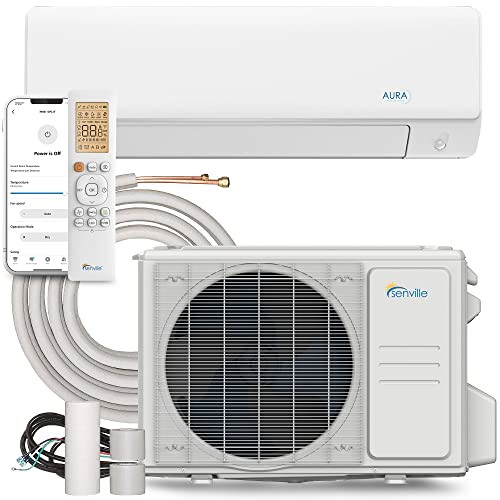
The Senville AURA 12K is a 12,000 BTU single-zone heat pump built around two selling points: a very high efficiency rating and a stated ability to keep heating when the outdoor temperature drops far below zero. It runs on 208/230V and uses the newer R-454B refrigerant. That combination makes it the most cold-weather-oriented model in our group and one of the more involved to install.
We do not test products. This profile uses the specifications Senville publishes on its SENA-12HF page, along with public guidance from ENERGY STAR and the EPA, and it flags anything the page leaves out.
Quick Facts
According to Senville:
- 12,000 BTU capacity, with a cooling range of 3,500 to 13,500 BTU and a heating range of 4,000 to 14,500 BTU
- 25.4 SEER2
- HSPF2 of 10.5 for region IV and 8 for region V
- 208/230V, single phase, 60 Hz, with an operating range of 187 to 253 V
- R-454B refrigerant, a 40.92 oz charge, pre-charged for installations up to 25 ft
- Designed to heat down to -30°C (-22°F)
- Indoor sound of 47, 40, 34, and 24 dB(A) on turbo, high, medium, and low, and 57 dB(A) outdoors
- Recommended for 500 to 750 sq ft
- Wiring of 14x4 AWG, a minimum circuit ampacity of 12 A, and a maximum fuse of 15 A
- ENERGY STAR certified; the page says it can reduce annual energy costs by up to 56%
- Warranty of 10 years on the compressor and 5 years on parts, subject to Senville’s terms
The Senville page we cite is an open-box listing for the SENA-12HF, which describes the same model.
Who It’s For
This is a good match for homeowners in the northern states who want a mini split as the main or a major heat source for a living area, a basement, an addition, or a cabin. The 4,000 to 14,500 BTU heating range and the high HSPF2 figures make it appealing where winter heating bills matter more than summer cooling. It also fits buyers who want a long compressor warranty and are comfortable paying a certified installer.
Who Should Skip It
Skip it if you want a DIY quick-connect kit. Skip it if the only circuit you can reasonably add is 115V, because this unit needs 208/230V. Skip it if you want built-in Wi-Fi and an app, since Senville’s page does not list Wi-Fi. Finally, skip it if you only need a small bedroom unit, because the 500 to 750 sq ft recommendation points to larger spaces, and a unit sized well above the room can cycle more than you would like.
Capacity and Sizing
Senville’s coverage range of 500 to 750 sq ft is wide, and the company is clear that insulation, climate, windows, ceiling height, and sun exposure move the answer. ENERGY STAR recommends that a contractor verify sizing with a Manual J calculation. That advice matters even more for heat-first buyers: a house that loses heat quickly needs more capacity at the design temperature than a square-foot rule implies. Inverter turndown (the 3,500 BTU low end of the cooling range) helps the unit avoid short cycling in mild weather.
Efficiency Numbers, Explained
SEER2 measures seasonal cooling efficiency. HSPF2 measures seasonal heating efficiency and is rated by climate region; region IV covers much of the middle of the country, while region V is the colder north. Senville lists 10.5 for region IV and 8 for region V, so it keeps a high figure even in the colder rating. At 25.4, the SEER2 is the highest of the nine models in this group. A higher number lowers running cost, but only if the unit is sized and installed correctly.
The headline figure is the -22°F minimum heating temperature that Senville lists. Read it carefully: a minimum operating temperature is the point at which the unit is designed to keep running, not the temperature at which it delivers its rated capacity. ENERGY STAR’s page notes that cold climate certification requires third-party testing down to 5°F, which is a separate, more meaningful benchmark. Senville’s page lists ENERGY STAR certification but does not state a cold-climate designation or capacity at 5°F in the text we read, so check Senville’s technical documents or the ENERGY STAR product finder if that figure matters.
For cold sites, mount the outdoor unit on a stand above the typical snow line, keep it clear of roof runoff and drifting snow, leave room for the unit to shed defrost water, and keep a backup heat source for the coldest nights.
Installation
Senville is direct that this is not a DIY kit. The page says the R-454B system must be installed and commissioned by a qualified professional, and that labor and building-specific materials are not included. Line set kits come in 16, 25 or 50 ft, and a 50 ft run needs refrigerant added on site. The unit is pre-charged for up to 25 ft.
Under EPA’s Section 608 rules, technicians who add or remove refrigerant, or otherwise open a system, must be certified. A professional install includes a vacuum and leak check, which protects both performance and warranty. The electrical side needs a dedicated 208/230V circuit sized to the listed 12 A minimum circuit ampacity and 15 A maximum fuse, plus a disconnect, installed under the National Electrical Code and local rules by a licensed electrician where required. Ask your building department whether a permit applies.
Noise
Senville lists indoor sound from 24 dB(A) on low to 47 dB(A) on turbo, and 57 dB(A) outdoors. The outdoor figure is higher than some DIY units list, so consider where the condenser will sit relative to bedroom windows and property lines. These are manufacturer numbers, and a real room can sound different.
Smart Controls
Senville’s page lists Alexa as enabled. Control is through the included remote, voice commands or the Alexa app, using the included USB kit. Wi-Fi is not described on the page. If you want a full app with schedules, confirm what the kit supports before you buy.
Warranty
Senville lists a 10-year compressor warranty and a 5-year parts warranty, subject to its terms. The compressor term is the longest standard one among our nine picks. Keep your installer’s invoice and commissioning notes, and read any registration requirements.
What to Check Before Buying
- Available 208/230V circuit capacity, and the run from the panel
- Line set length: pick the kit that matches the distance, and note the 25 ft pre-charge limit
- Whether your region lists permits for HVAC and electrical work
- Heating needs in your coldest weeks, and whether backup heat is in place
- Incentives. The federal 25C credit applied to property placed in service through December 31, 2025, so it has expired for 2026 installs. Utility rebates may exist; ENERGY STAR’s Rebate Finder is the place to look.
Alternatives Among Our Picks
If you need a 115V unit with stated cold performance, the Della Optima 12K lists heating to -13°F. For a DIY approach in milder climates, see the MRCOOL DIY 4th Gen 12K.
Final Take
The Senville AURA 12K is a heat-first, efficiency-first mini split with a long compressor warranty. The trade-offs are clear: professional installation, a 230V circuit, and no built-in Wi-Fi. For northern homeowners who accept those, it is the strongest cold-weather candidate in this group.
See price on Amazon
To see how this system ranks against the eight other mini splits we compared, read our ranking of the best mini splits of 2026.
Sources